Portability Model
NavHAL achieves portability through structured separation of hardware concerns and compile-time specialization. Instead of relying on runtime abstraction layers, the system follows a clear adaptation flow where only the required components are implemented or replaced based on the target platform.
Porting Flow Overview
Portability in NavHAL follows a layered adaptation path:
Application → Interface → Core → Vendor → Board → Hardware
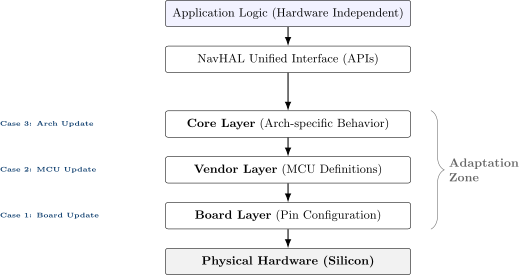
The application and interface layers remain unchanged. Porting is performed by adapting the lower layers depending on what changes in the hardware platform.
Case 1: Porting to a New Board (Same MCU)
When the microcontroller remains the same but the physical board changes, only the board layer needs to be updated.
Flow:
Define board-specific pin mappings (e.g., mapping logical pins to actual GPIOs)
Configure default peripherals (LEDs, communication ports, etc.)
Update linker script if memory layout differs
Impact:
No changes required in core or vendor layers
No changes required in application code
This is the simplest portability case and enables reuse of the entire software stack across different hardware layouts.
Case 2: Porting to a New Microcontroller (Same Architecture)
When moving to a different microcontroller within the same architecture (e.g., STM32F401 → STM32F411), the vendor layer is adapted.
Flow:
Define register base addresses and peripheral mappings
Update memory layout and peripheral availability
Provide vendor-specific definitions required by the core layer
The core layer continues to use these definitions to implement peripheral behavior.
Impact:
Core logic remains unchanged
Board layer may require minor updates
Application code remains unchanged
This separation allows reuse of peripheral logic while adapting only low-level hardware details.
Case 3: Porting to a New Architecture
When targeting a completely different processor architecture (e.g., moving from Cortex-M4 to another architecture), a new core layer must be implemented.
Flow:
Implement architecture-specific startup code and interrupt handling
Provide core implementations for all common HAL APIs
Integrate vendor-specific register definitions for the new platform
Impact:
Vendor and board layers are built on top of the new core
Interface remains unchanged
Application code remains unchanged
Although this is the most involved step, it is performed once per architecture and reused across multiple platforms.
Compile-Time Binding
All portability decisions are resolved at compile time through build configuration parameters such as:
Target processor (core)
Vendor family
Board configuration
The build system includes only the selected implementations, ensuring:
No runtime branching or hardware detection
Reduced binary size
Direct mapping to hardware
Key Observation
In all cases, the upper layers of the system remain unchanged. Portability is achieved by replacing only the minimal required layer:
| Change Type | Layer Modified |
|---|---|
| New Board | Board Layer |
| New MCU (same arch) | Vendor Layer |
| New Architecture | Core Layer |