The Need for Indigenous Flight Control Software in India
The Need for Indigenous Flight Control Software in India
India is experiencing a silent technological transformation. Across the country, drones are beginning to move beyond research labs and hobbyist workshops into real-world deployment. They are surveying farmland, inspecting infrastructure, monitoring disaster zones, supporting defense operations, and slowly becoming a part of everyday industrial systems. The drone ecosystem in India is growing rapidly, fueled by startups, government initiatives, research institutions, and a new wave of young engineers who want to build autonomous systems within the country.
But beneath this visible growth lies an uncomfortable reality: while India is building drones, much of the intelligence powering them still depends on software ecosystems developed elsewhere.
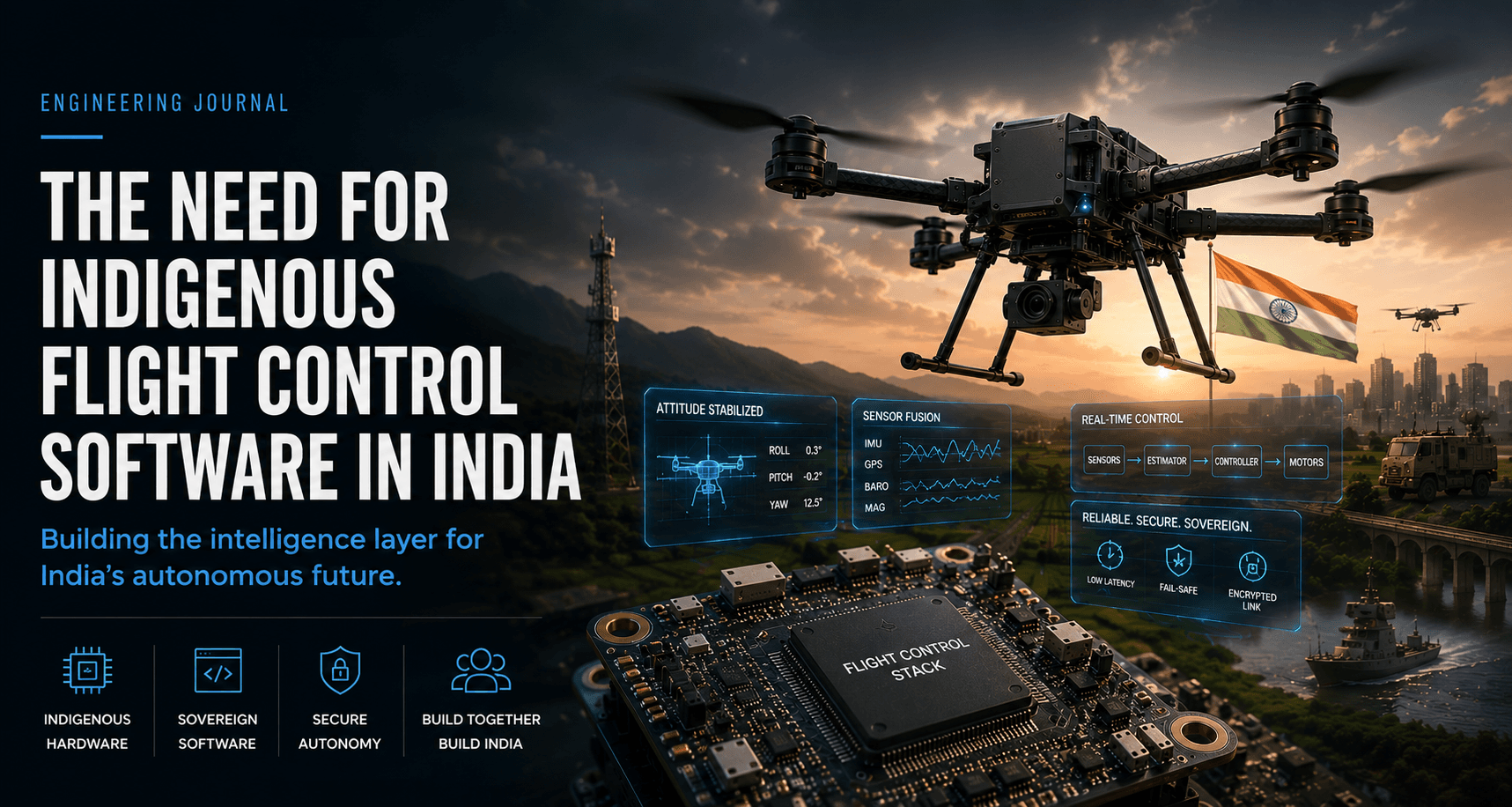
The average person sees a drone as a collection of motors, propellers, batteries, and cameras. In reality, the most important part of a drone is invisible. Deep inside every autonomous system lies its flight-control software — the layer responsible for stabilization, navigation, sensor processing, communication, and real-time decision making. This software acts as the nervous system of the aircraft. It decides how the drone reacts to wind, how it balances itself in the air, how it responds to sensor data, and how it survives failures in unpredictable environments.
For years, India has relied heavily on foreign flight stacks, middleware, development frameworks, and embedded software infrastructure. These systems are powerful, mature, and widely adopted across the world. They helped accelerate innovation globally and lowered the barrier to entry for drone developers. However, dependence on external software ecosystems also creates long-term limitations, especially for a country that aims to become self-reliant in strategic technologies.
The challenge is not simply about nationalism or replacing foreign technology for symbolic reasons. The issue is deeper. Autonomous systems are becoming part of critical infrastructure. Drones are increasingly connected to defense, logistics, surveillance, agriculture, and industrial automation. As these systems become more important, the software controlling them becomes strategically significant. A country that does not control its own autonomous software stack ultimately remains dependent at the most fundamental level.
India has already recognized the importance of semiconductor development and indigenous hardware manufacturing. New processor and SoC companies are emerging with ambitions to power embedded systems, robotics platforms, and AI devices. Yet hardware alone cannot create an ecosystem. A processor becomes useful only when developers can easily build reliable systems around it. Without robust software support — drivers, RTOS integration, middleware, hardware abstraction layers, and development tools — even promising chips struggle to achieve adoption.
This is one of the biggest gaps in India’s current embedded ecosystem. The country is beginning to build silicon, but there are still very few indigenous software platforms designed to connect that silicon to real-world autonomous applications. Most developers continue to optimize for existing foreign ecosystems because they are mature, accessible, and already supported by the broader industry.
An indigenous flight-control ecosystem could change this equation entirely.
Imagine a hardware abstraction layer designed specifically to support Indian processors, Indian sensor ecosystems, and Indian embedded hardware. Imagine a real-time operating system optimized for autonomous systems being developed domestically alongside the hardware it runs on. Instead of adapting Indian hardware to foreign software ecosystems, developers could begin building software and hardware together from the ground up. This co-development approach is how truly powerful technology ecosystems emerge.
Real-time software is especially important in autonomous systems because drones do not have the luxury of delayed decision making. A tiny delay in sensor processing or motor response can destabilize an aircraft within milliseconds. Flight-control systems operate under strict timing constraints where predictability matters more than raw computing power. As drones evolve toward onboard AI, swarm coordination, edge inference, and autonomous navigation, control over low-level real-time infrastructure becomes increasingly critical.
India also faces operating conditions that differ significantly from many environments where existing flight stacks were originally developed. High temperatures, dust-heavy environments, rural deployments with poor connectivity, mountainous terrain, and dense urban regions create unique engineering challenges. Indigenous systems can be optimized specifically for these realities rather than relying on generic assumptions made for global markets.
However, the importance of indigenous flight-control software extends far beyond drones. The same foundational technologies can power robotics systems, autonomous vehicles, industrial automation platforms, intelligent edge devices, and future AI-driven machines. A strong domestic HAL and RTOS ecosystem could become the backbone for an entire generation of Indian autonomous technologies.
The most important part of such an ecosystem is openness and collaboration. India does not need isolated proprietary silos. It needs platforms that allow startups, researchers, semiconductor companies, universities, and manufacturers to build together. The goal should not simply be to create another firmware stack. The goal should be to create a shared technological foundation that enables faster innovation across the entire industry.
Countries that dominate the future of autonomous systems will not do so merely because they manufacture hardware. They will lead because they control the software infrastructure connecting hardware to intelligence. The future of robotics and autonomous systems will be shaped not only by AI models or processors, but by the deeply integrated real-time software layers underneath them.
India now stands at an important moment. The country has the talent, the startup ecosystem, the semiconductor momentum, and the strategic need to build indigenous autonomous infrastructure. What is needed next is the willingness to invest in foundational software systems that may not always be visible to the public but are critical for long-term technological independence.
Building indigenous flight-control software is not just about writing code for drones. It is about building the digital foundation for India’s autonomous future.
Build the Sovereign Future.
We are actively partnering with developers, researchers, and institutions to build out this intelligence layer. Ready to collaborate?
Join the Mission